The Great Dictator 1939 1941 next previous
The Great Dictator Clippings 143/369
Ira Wolfert, NANA, Dayton Daily News, Dayton, O., Oct. 14, 1940.
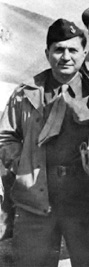
Ira Wolfert as War Correspondent, 1940s, American
Air Museum in Britain, detail
„I hope ridicule is a weapon“
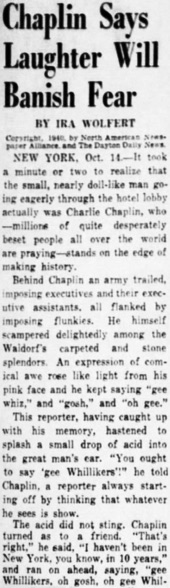
Editorial content. „Chaplin Says Laughter Will Banish Fear
BY IRA WOLFERT
(North American Newspaper Alliance.)
New York, Oct. 14. – It took a minute or two to realize
that the small, nearly doll-like man going eagerly
through the hotel lobby actually was Charlie Chaplin, who –
millions of quite desperately beset people all over
the world are praying – stands on the edge of making
history.
Behind Chaplin an army trailed, imposing executives and
their executive assistants, all flanked by imposing flunkies.
He himself scampered delightedly among the Waldorf‘s carpeted
and stone splendors. An expression of comical awe rose
like light from his pink face and he kept saying ,gee whiz,‘ and
,gosh,‘ and ,oh gee.‘
This reporter, having caught up with his memory, hastened
to splash a small drop of acid into the great man‘s ear.
,You ought to say ,gee Whilllikers‘!‘ he told Chaplin, a reporter
always starting off by thinking that whatever he sees
is show.
The acid did not sting. Chaplin turned as to a friend. ,That‘s
right,‘ he said, .I haven‘t been in New York, you know,
in 10 years,‘ and ran on ahead, saying ,gee Whillikers, oh gosh,
oh gee Whillikers.‘ He has a small, very pleasant voice,
tweaked at the edges by a slight British accent.
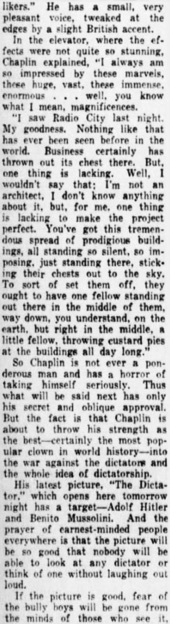
In the elevator, where the effects were not quite so stunning, Chaplin explained, ,I always am so impressed by these
marvels, these huge, vast, these immense, enormous . . . well,
you know what I mean, magnificences.
,I saw Radio City last night. My goodness. Nothing like
that has ever been seen before in the world. Business
certainly has thrown out its chest there. But, one thing is lacking.
Well, I wouldn‘t say that; I‘m not an architect, I don‘t
know anything about it, but, for me, one thing is lacking to make
the project perfect. You‘ve got this tremendous spread
of prodigious buildings, all standing so silent, so imposing, just
standing there, sticking their chests out to the sky.
To sort of set them off, they ought to have one fellow standing
out there in the middle of them, way down, you
understand, on the earth, but right in the middle, a little fellow,
throwing custard pies at the buildings all day long.‘
So Chaplin is not ever a ponderous man and has a horror
of taking himself seriously. Thus what will be said
next has only his secret and oblique approval. But the fact
is that Chaplin is about to throw his strength as the
best – certainly the most popular clown in the world history
– into the war against the dictators and the whole
idea of dictatorship.
His latest picture, The Dictator, which opens here
tomorrow night has a target – Adolf Hitler and
Benito Mussolini. And the prayer of earnest-minded people
everywhere is that the picture will be so good that
nobody will be able to look at any dictator or think of one
without laughing out loud.
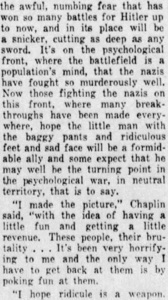
If the picture is good, fear of the bully boys will be gone
from the minds of those who see it, the awful,
numbing fear that has won so many battles for Hitler up to
now, and in its place will be a snicker, cutting
as deep as any sword. It‘s on the psychological front, where
the battlefield is a population‘s mind, that the nazis
have fought so murderously well. Now those fighting the nazis
on this front, where many breakthroughs have been
made been made everywhere, hope the little man with the
baggy pants and ridiculous feet and sad face will
be a formidable ally and some expect that he may well
be the turning point in the psychological war,
in neutral territory, that is to say.
,I made the picture,‘ Chaplin said, ,with the idea of having
a little fun and getting a little revenue. These people,
their brutality . . . It‘s been very horrifying to me and the only way
I have to get back at them is by poking fun at them.
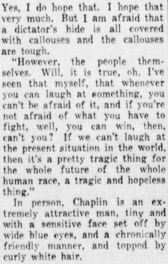
,I hope ridicule is a weapon. Yes, I do hope that. I hope
that very much. But I am afraid that a dictator‘s hide
is all covered with callouses and the callouses are tough.
,However, the people themselves. Will, it is true,
oh, I‘ve seen that myself, that whenever you can laugh at
something, you can‘t be afraid of it, and if you‘re not
afraid of what you have to fight, well, you can win, then, can‘t
you? If we can‘t laugh at the present situation in the
world, then it‘s a pretty tragic thing for the whole future of the
whole human race, a tragic and hopeless thing.‘
In person, Chaplin is an extremely attractive man, tiny and
with a sensitive face set off by wide blue eyes,
and a chronically friendly manner, and topped by curly
white hair.“
Also in Times-Tribune, Scranton, Pa., Oct. 14, 1940.
Title: „Chaplin Asserts Laughter Is Usually Cure For Fear“
The Great Dictator world premiere is in New York Oct. 15, 1940
at the Capitol and Astor Theatres.
Capitol Theatre, 1645 Broadway (at 51st Street), New York.
Astor Theatre, 1531 Broadway (at 45th Street), New York.
Redaktioneller Inhalt
The Great Dictator 1939 1941 next previous