City Lights 1930 1931 1932 next previous
City Lights Clippings 244/387
Herman G. Weinberg, Close Up, Territet, Switzerland, March 1931.
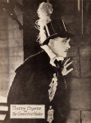
Harry Myers as The Connecticut Yankee
(...) Photo, Motion Picture News, Feb. 26, 1921
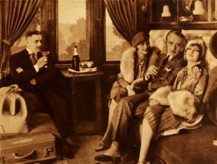
& Harry Myers, as Friedenthal in „The Wonder of Women,“
observes with misgivings Tromholt‘s susceptibility
to Bess Flowers, left, and Ethlyne Clair.
(...) Photo, Picture Play, Aug. 1929
& CITY LIGHTS – Chaplin-United Artists
At last! – Chaplin‘s long-awaited silent picture, the first big
silent since talkies, It proves his contention – should
he utter one word, the inimitable magic of this arch-pantomimist
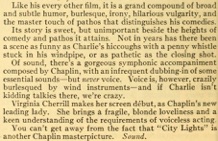
would go pft! As a silent epic of pantomime, City Lights
is a ninety-minute delight; as a talkie, it would have been just
another talkie. (...)
Virginia Cherrill makes her screen début, as Chaplin‘s
new leading lady. She brings a fragile, blonde loveliness and a keen understanding of the requirements of voiceless acting.
You can‘t get away from the fact that City Lights is another
Chaplin masterpiece. Sound.
(...) The Shadow Stage A Review of the New Pictures,
Photoplay, March 1931
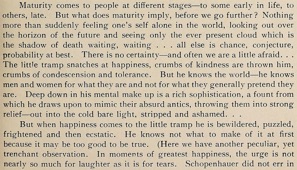
„In the beginning there was Charlie Chaplin...“
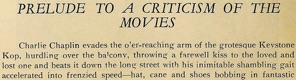
Editorial content. „PRELUDE TO A CRITICISM
OF THE MOVIES
Charlie Chaplin evades the o‘er-reaching arm of the
grotesque Keystone Kop, hurdling over the balcony, throwing
a farewell kiss to the loved and lost one and beats it down
the long street with his inimitable shambling gait accelerated into frenzied speed – hat, cane and shoes bobbing in fantastic
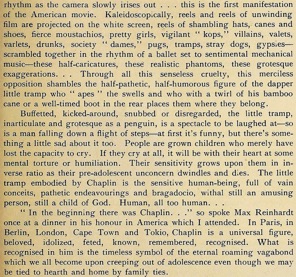
rhythm as the camera slowly irises out... This is the first manifestation
of the American movie. Kaleidoscopically, reels and
reels of unwinding film are projected on the white screen, reels
of shambling hats, canes and shoes, fierce moustachios,
pretty girls, vigilant ,kops,‘ villains, valets, varlets, drunks, society
,dames,‘ pugs, tramps, stray dogs, gypses – scrambled
together in the rhythm of a ballet set to sentimental mechanical
music – these half-caricatures, these realistic phantoms,
these grotesque exaggerations... Through all this senseless cruelty,
this merciless opposition shambles the half-pathetic,
half-humorous figure of the dapper little tramp who ,apes‘ the
swells and who with a twirl of his bamboo cane or a
well-timed boot in the rear places them where they belong.
Buffetted, kicked-around, snubbed or disregarded,
the little tramp, inarticulate and grotesque as a penguin, is a
spectacle to be laughed at – so is a man falling down
a flight of steps – at first it‘s funny, but there‘s something
a little sad about it too. People are grown children who
merely have lost the capacity to cry. If they cry at all, it will be
with their heart at some mental torture or humiliation.
Their sensitivity grows upon them in inverse ratio as their pre-adolescent unconcern dwindles and dies. The little
tramp embodied by Chaplin is the sensitive human-being,
full of vain conceits, pathetic endeavourings and
bragadocio, withal still an amusing person, still a child
of God. Human, all too human...
,In the beginning there was Charlie Chaplin...‘ so spoke
Max Reinhardt once at a dinner in his honour in America which
I attended.“ (...)
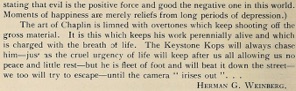
„The art of Chaplin is limned with overtones which keep
shooting gross material. It is this which keeps his work
perennially alive and which is charged with the breath of life.
The Keystone Kops will always chase him – just as the
cruel urgency of life will keep after us all allowing us no peace
and little rest – but he is fleet of foot and will beat
it down the street – we too will try to escape – until the
camera ,irises out‘...
Herman G. Weinberg.“
The world premiere of City Lights takes place in Los Angeles
January 30, 1931 at the Los Angeles Theatre.
Los Angeles Theatre, 615 South Broadway (between
6th and 7th Streets), Los Angeles.
City Lights opens in New York February 6, 1931
at the Cohan Theatre.
George M. Cohan Theatre, 1482 Broadway (between
42nd and 43rd Streets), New York.
Redaktioneller Inhalt
City Lights 1930 1931 1932 next previous